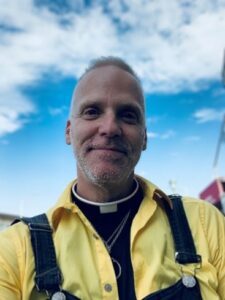
 Alumnx Council member Rev. Todd Atkins-Whitley first shared this reflection in PSR’s June 2026 Alumnx newsletter, just before summer break. In “This, I believe,” Todd reflects on how ordinary people, moved by faith and hope, have helped expand God’s realm of love through acts of courage, resistance, and care.
Ever since God’s realm of love and heaven broke through to this earth, I believe ordinary people have boldly grasped at its edges, pulling, stretching, and straining to spread it ever wider. Yes, ordinary people through every age: resistors, revolutionaries, radicals, reformers, each one who believed in what God’s realm of love could become, even when they could not see it. They risked it all to expand it more broadly in their lifetimes and for the generations to come.
Like those women that first Easter morning. Women filled with grief and fear. Women who refused to be silent. They rushed to tell the good news to anyone who would listen.
Like those earliest disciples: fishermen, tent makers, craftspeople, people whose faith animated them to not only proclaim good news, but also labor, even giving their lives to see it realized in the face of empire’s misdeeds and its unquenchable thirst for power.
Ordinary women, philosophers, mystics, and nuns who pushed mightily against the patriarchy through their care for the poor, through art and music and literature, through direct political pressure demanding economic and religious autonomy for women, and who lifted up the sacredness of God’s maternal nature.
Ordinary men, scholars, defenders, and proclaimers who rebelled against the indulgences of religion, spoke out against the creep of fascism, decried the horrors of war, and worked toward peace.
Ordinary people in pre-modern eras who, at great risk, lived out their authentic gender identity, their sexuality, and their right to transgress societally accepted roles, insisting with their very bodies that they, too, were created in the image of the divine.
Ordinary people who migrated to foreign lands looking for a better life for themselves, their families, and their descendants; who built a nation; and who faced incarceration and displacement, demonstrating the natural flow of human migration.
Ordinary people who were ripped from their homelands, told they were less than human, and found hope in the story of the Exodus. They gave voice to the spirituals, demanding that God’s realm most certainly included them.
Ordinary people who smuggled slaves to freedom, sat at lunch counters, picketed in Birmingham and Memphis, marched across bridges and country roads, and preached mighty sermons demanding, often with their very lives, the dignity of those who had been enslaved and of their descendants.
And ordinary people who cared for dying AIDS patients when no one else would; pushed back when religious voices said their sickness and death were evidence of God’s judgment; chained themselves to fences to oppose nuclear weapons; insisted that Black Lives Matter; chanted “Water is life”; proclaimed “Trans is beautiful”; contended that migration, healthcare, clean water, and housing security are human rights; blocked deployments of ICE agents and stood in front of immigrants to protect them; and asserted that everyone deserves life, liberty, and the opportunity to pursue happiness.
Saints! All of them. But ordinary people, each one. Imperfect, but perfectly defending and expanding God’s realm of love with each fearless act.
You see, God’s realm of love has always been emerging, ever-advancing through the efforts of ordinary people, animated by God’s Holy Spirit. They are guided by God’s still, small voice. They tirelessly place their hope in the unseen, yet hold faith that someday it will come to pass. Ordinary people pull at the realm’s edges, stretch it to the margins, and expand its borders ever wider so all people are included and experience liberation.
Not perfect people, but people who understand that God’s realm widens when we participate in its expansion: dismantling systems of domination, rising up in times of bleakness and oppression, lifting up the marginalized, and marching alongside them.
And so, I believe this is our moment, us ordinary people. We are called not to be perfect, not to be arrogant in our faith, and not to debate dogma, but to rise up, resist, reform, and revolt against every unjust system, every instance of tyranny and authoritarianism, and every structure designed to imprison and ensnare.
Like those who have come before us, this is our moment to advance God’s realm.
THIS I BELIEVE.